A News Paywall Counts Your Free Articles and a Stranger Starts From Zero
Many news sites give you a few free articles a month, then ask you to subscribe. The count has to live somewhere, and on most sites it lives in your browser: a cookie that goes up by one with every article. This case study uses a made-up news site, The Daily Ledger, with a meter of three.
For a reader, that explains why a private window sometimes gets you past the wall. For a publisher, it’s worth knowing what a newcomer sees, and how easy the meter is to reset.
Open the site in Unweb and reload until the meter runs out. Then click Side by side.
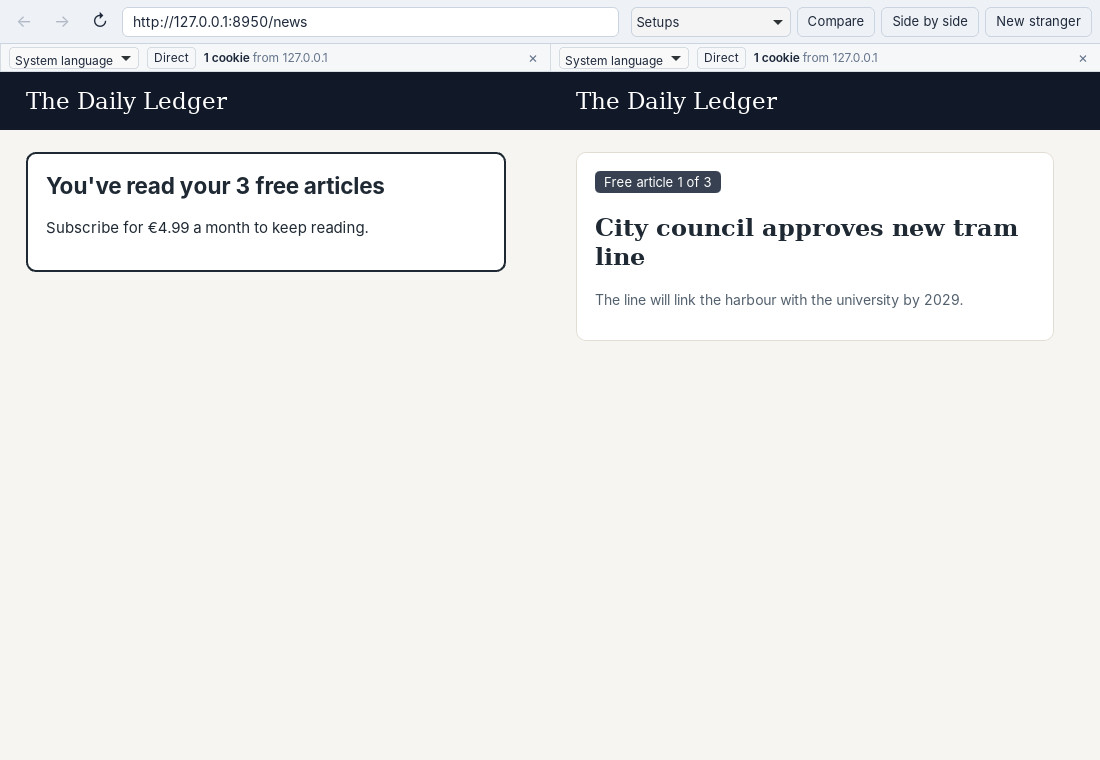
Left, a stranger that has used up its free articles. Right, a stranger opened beside it a moment later.
What It Shows
The first stranger hit the wall after three articles. The second, in the same window a second later, is on article one of three. Each strip shows one cookie from the site, and it’s a different cookie: the meter. A new stranger has no meter, so it starts from zero.
Close the first stranger and its meter is deleted with everything else. Nothing carries over to the next one.
For Publishers
If a meter is meant to hold, a cookie alone won’t hold it against anyone who opens a new window. That may be fine, and many publishers accept it on purpose. But it’s worth checking what a first-time reader actually gets, and Unweb shows that without logging out of anything or clearing your own browser.
The made-up site is in examples/case-studies in Unweb’s repository; open http://127.0.0.1:8950/news after starting server.py.